Combat Robotics
I founded a combat robotics team with one other person and designed a 3 lb beetleweight spinner. A different design problem to FTC: here the robot has to survive being hit, and everything is traded against weapon energy and armour inside a hard weight limit.
- Role
- Founder and mechanical lead
- Organisation
- Beetleweight combat team
- Dates
- 2022–23
- Class
- 3 lb beetleweight
- Tags
- Fusion 360 · Weapon drive · Armour · Belt drive
- Weight class
- 3 lb beetleweight
- Weapon
- Belt-driven spinning bar
- Team
- Two people — I led mechanical design
- Competition
- BCRC events
- Tools
- Fusion 360, FDM printing, machined plate
Why it exists
I had been designing FTC robots for two seasons and wanted a problem that punished different mistakes. In FTC, a mechanism fails by being slow or inconsistent. In combat, it fails by coming apart.
So a friend and I started a beetleweight team and entered BCRC events. Everything about the robot — plate thickness, fastener choice, how the weapon mounts — had to be argued against a 3 lb limit that leaves no room for a part that is heavier than it needs to be.
How the design drivers differ from FTC
An FTC robot is designed around cycle time and repeatability. It gets one alliance partner, a known field, and no opponent actively trying to break it. The right answer is usually the mechanism that scores fastest with the fewest ways to jam.
A combat robot is designed around energy and survivability. The weapon needs enough stored energy to matter, which means mass at a radius spinning fast, and every gram spent there is a gram not spent on armour or drive. The robot also has to absorb the reaction to its own hits.
That flips the design process. In FTC I optimised for precision and speed. Here I optimised for load paths — where does the impact go, what does it pass through, and what fails first when it arrives. Fasteners want to back out, printed parts want to split at layer lines, and anything cantilevered is a liability.
It also changes what "done" means. An FTC mechanism is done when it works reliably. A combat robot is done when it can lose a fight and be repaired between matches, which pushed me toward a design where the weapon assembly and the drive could be taken apart independently.
How it works
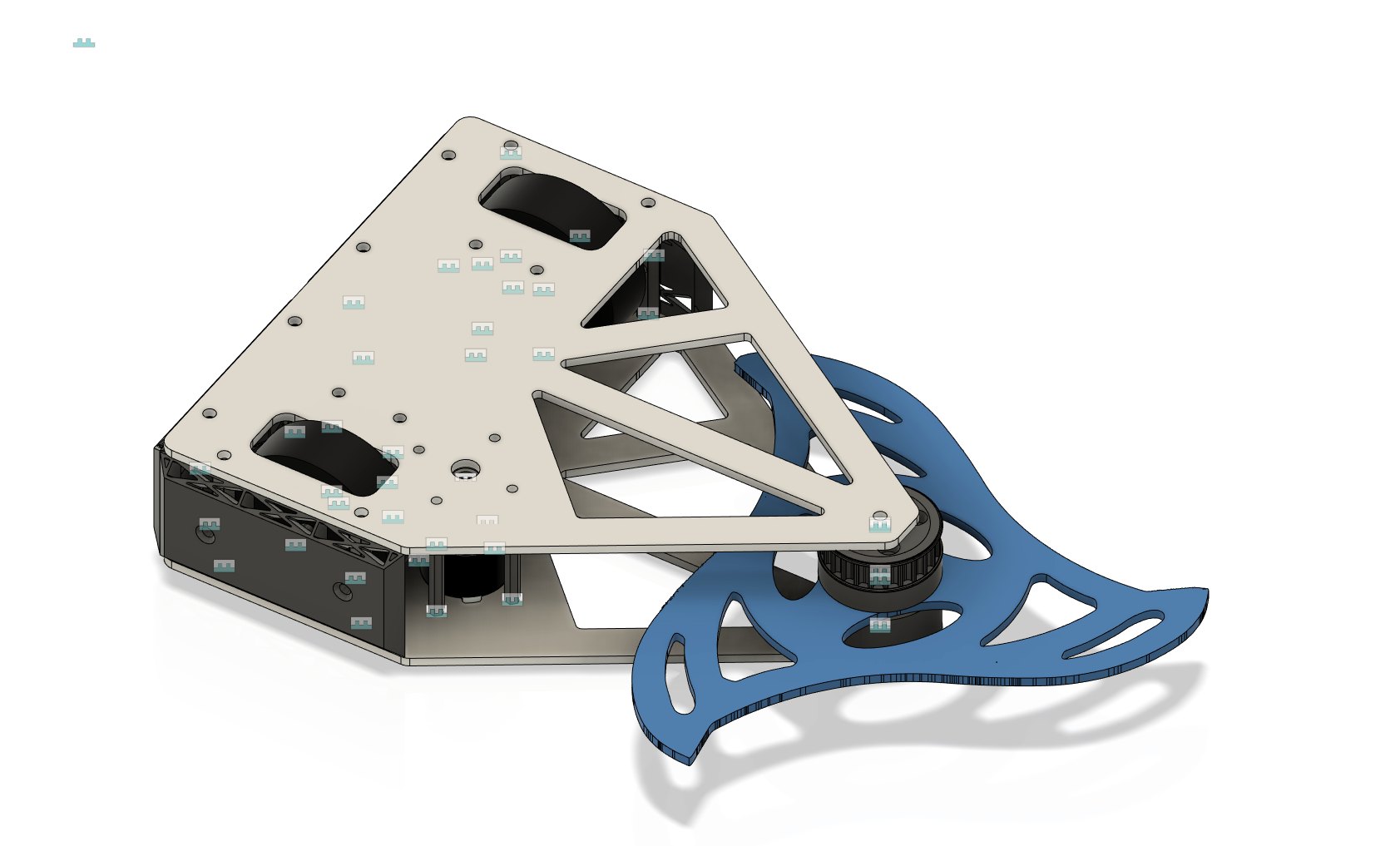
The weapon is a spinning bar driven by a brushless motor through a belt reduction. The motor sits inboard, low and central, and drives a pulley on the weapon hub, so the heaviest rotating part is supported by bearings in the frame rather than hung off the motor shaft.
The chassis is a machined plate structure with printed internals. Putting the weapon on a belt rather than direct-driving it means the motor is isolated from the shock of an impact — the belt slips or the pulley takes the abuse before the motor bearings do.
The blue weapon bar is the sacrificial part by design. It is the piece that makes contact, so it is the piece that gets replaced.
In the arena
Gallery
I wrote the "how it works" section from the CAD and photos — belt reduction, inboard motor, bearings in the frame, sacrificial bar. Correct anything I got wrong, and add the numbers if you have them: weapon mass and tip speed, plate material and thickness, drive motors, and match record.