← All projects FTC Team 13216 Deja Vu

FTC Robotics

I founded FTC team 13216 Deja Vu and led it for four seasons. Four robots, each 30–50 custom printed parts inside a 500+ part assembly. This is where I taught myself SolidWorks.

Role
Founder and team lead
Organisation
FTC Team 13216 Deja Vu
Dates
Sept 2021 – Mar 2025
Status
Four seasons
Tags
SolidWorks · FDM · Mechanism design · Team lead
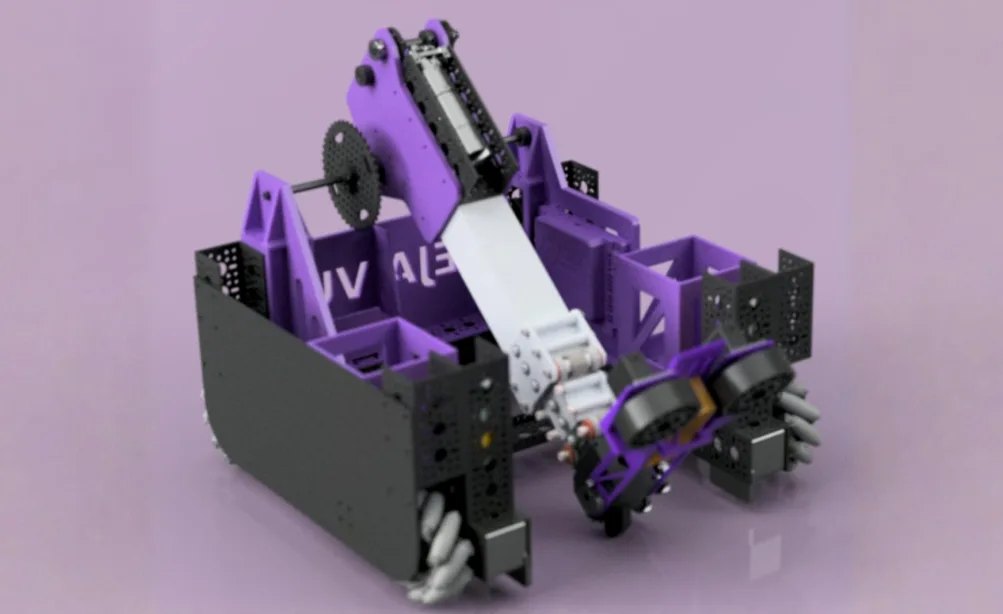
CAD render of the INTO THE DEEP competition robot.
Seasons
Four, 2021–22 through 2024–25
Role
Team lead all four seasons, mechanical lead for the first two
Custom printed parts
30–50 per robot
Full assembly
500+ parts per robot
Awards
Best Robot Design, Inspire Award, NorCal regional qualifier

Context

I founded FTC team 13216 Deja Vu and led it for four seasons, and I was mechanical lead for the first two as well until Aadit joined and we split the design work roughly evenly.

Every robot was designed in CAD before it was built. The part counts above are the full assemblies, of which 30–50 per robot were custom components we designed and printed ourselves.

Four seasons of doing this is where I learned SolidWorks, learned to design for a manufacturing process I actually had access to, and learned that a mechanism which works on the bench is not the same as one that works in a match.

What follows is one mechanism story per season rather than a season recap — the problem that was actually interesting to solve that year.

2024–25 · Team lead

INTO THE DEEP

Best Robot Design award · Qualified for NorCal regional

The interesting problem that year was the arm. I took a telescoping arm architecture normally seen on much larger FRC robots and adapted it to FTC — shortening the stages and gearing down our substantially weaker FTC motors so they could still drive the arm in and out under load.

On top of that I designed a gear-driven mechanism that flips the whole arm through vertical, so the robot could intake scoring elements at the front and score them behind and above itself without turning around.

The arm modification fought us the whole way. Getting FTC motors to drive an FRC-scale telescoping mechanism took several iterations of gearing and stage length before it was reliable enough to trust in competition — but it did work in competition.

2023–24 · Team lead and CAD lead

CENTERSTAGE

Qualified for NorCal regional

The hard problem was intake consistency. Our first designs only worked from a near-perfect approach angle, which meant the driver was spending the match lining up instead of scoring.

Several iterations of flexible plastic grabbers, together with a custom ramp and bucket, got us to an intake that took elements in reliably from a range of approaches. The bucket used servo-driven locks to hold the elements in place so it could be flipped back to score without spilling them.

CAD walkaround of the ramp and bucket assembly, with a pixel staged in the transfer path.
2022–23 · Team lead and mechanical lead

POWERPLAY

Inspire Award · Qualified for NorCal regional

I designed and built this robot on my own. The mechanism worth talking about is the grabber: it expands inside the scoring element to grip it from the inside, then contracts to release, so scoring is a single motion with nothing to snag on the way out.

2021–22 · Founder and team lead

FREIGHT FRENZY

The founding season

The season I started the team. I taught myself SolidWorks to design that first robot, and everything I know about designing for a process I actually have access to started here.

TODO — Connor · founding season

This is the best story you have and it is currently one paragraph. Worth adding: one mechanism from that robot and what you did not know when you started. No images yet — if any exist, they belong here.

TODO — Connor · confirm the awards

Your notes claim the Inspire Award for both POWERPLAY and CENTERSTAGE. It is listed on POWERPLAY only here. Check the FTC records and correct whichever is wrong — it is exactly the kind of detail someone verifies.